

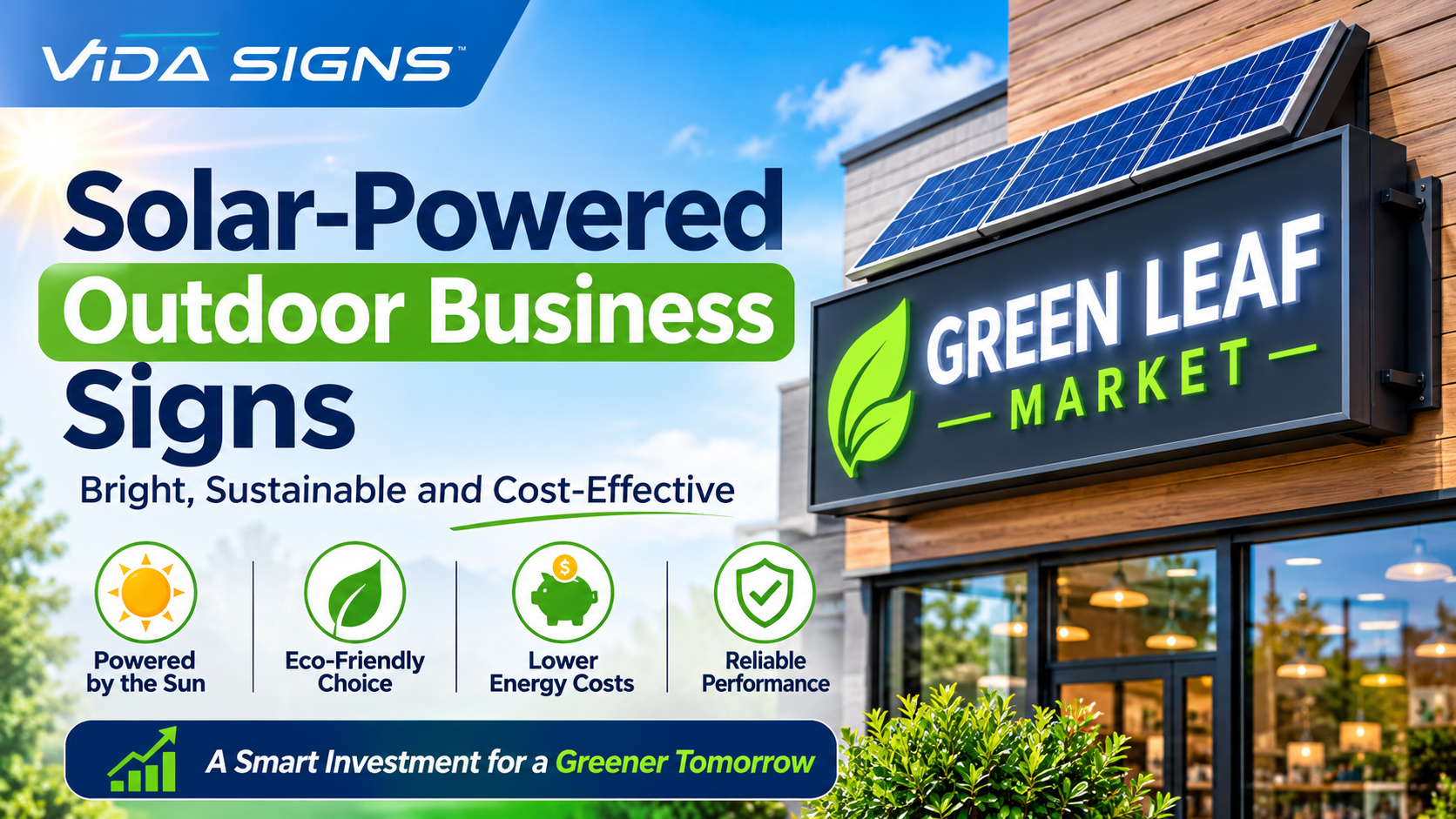
Solar-Powered Outdoor Business Signs
04 NovOutdoor signs are useful for helping customers locate a business, but keeping them lit can lead to higher electricity bills. Instead, solar technology can be used since it gathers sunlight during the day and stores the energy to use it at night.
For shops, parking areas, and roadside businesses, solar-powered outdoor business signs can lessen the need for electricity from the grid, especially in cases where laying in wiring would be costly. Yet their performance will depend on the amount of sunlight, the capacity of the battery, and the level of brightness needed.
The guide explains how solar signage functions, the advantages and disadvantages it has, the conditions required for installation, and also how to select the appropriate system.
What Are Solar-Powered Outdoor Business Signs?
Outdoor business signs that are powered by solar energy use sunlight to light up the letters, logos, or the face of the sign. A normal system consists of solar panels, a charge controller, a rechargeable battery, and LED lights.
These signs are suitable for use on commercial properties, at the entrances to retail shops, and in places where electrical access is not convenient.
Solar-Lit vs. Solar-Powered Illuminated Signs
Solar-powered signs can just reflect daylight, while those that are illuminated make use of solar energy that has been stored in order to give off light after sunset. Knowing the difference enables businesses to select signage that stays visible throughout their operating hours.
How Solar-Powered Signs Work
Solar panels produce electricity, the batteries store it, and the lighting systems use the energy whenever it is required. Each of the components has an impact on reliability.
Solar Panels & Charge Controllers
Panels are able to turn sunlight into electricity; a charge controller controls the energy that goes into the battery and thus helps to avoid overcharging, and the position of the panels is important since shade from buildings and trees can lower the amount of energy produced.
Battery Storage
Batteries provide power after sunset and when there is only a limited amount of sunlight; their capacity must correspond to the brightness of the sign and its operating schedule. A sign which is expected to remain lit all night requires more stored energy than one that is used for just a few hours in the evening.
LED Light Sources, Timers & Dusk Sensors
LEDs offer efficient lighting, and timers together with dusk sensors automate their operation. Solar-powered LED signs that are well designed can switch on when daylight diminishes and switch off at a specific time, thus reducing the amount of unnecessary energy consumption.
Types of Solar-Powered Business Signs
Different formats suit different locations, sizes, and visibility requirements.
Monument & Pylon Signs
The signs for the monument are positioned at a level with the ground, whereas those on the pylons are placed higher up in order to be visible from the roadside. Solar lighting is a useful option for lighting up these structures without having to run long electrical cables. When planning the layout, attention should be paid to the position of the panels, the exposure to wind, and the need for maintenance access.
A-Frame & Sidewalk Signs
A-frame signs carry advertisements for shops, cafés, and various services directly to pedestrians, and compact solar lighting could enhance night-time visibility; it is necessary for the panel and battery to fit in such a way that the sign remains easy to move.
Solar-Lit Storefront & Wall Signs
Signs displayed at the front of stores are used to identify the businesses and to strengthen brand recognition. Solar lighting can be used for custom LED signs in situations where there is no access to electricity, on the condition that the panel is exposed to sufficient sunlight and the system is capable of providing the necessary brightness.
Directional & Parking Lot Signs
Directional and parking signs assist visitors in navigating commercial properties at night, and solar power is especially useful in remote areas of a parking lot since conventional wiring would require extra groundwork.
Benefits of Solar-Powered Signs
Solar signage has a number of practical advantages, even though the extent of these benefits will differ according to the property and the system.
Lower Electricity Costs
Solar systems can produce electricity without taking all of their operating power from the grid, which may lead to lower ongoing energy costs, depending on the installation costs, the amount of sunlight available, and the need for battery replacements.
No Trenching or Wiring
Individual systems can avoid the need for long cables and digging trenches over paved surfaces. This will make the installation simpler and reduce the disturbance to the landscaping. However, attention still has to be paid to the structural mounting and electrical safety requirements.
Sustainability & Brand Image
If companies wish to cut down on their use of grid electricity, they might include eco-friendly business signs as part of their sustainability initiatives. Solar power can help to achieve this aim, but the total environmental impact also lies with the manufacturing process, battery disposal,l and the length of time the equipment lasts.
Operation During Power Outages
So long as a solar sign has a sufficient charge in its battery, it will be able to keep working when the power grid fails. It can thus help make the entrances and directions visible, but how well it performs will depend on the state of the battery and the amount of energy it contains.
Limitations & Things to Consider
Solar signage cannot be used in all situations, so it is necessary to evaluate the conditions before deciding on a system.
Sun Exposure, Shading & Seasonal Performance
Buildings, trees, and the roofs’ overhanging parts can have a reducing effect on charging. Shorter winter days and overcast weather may likewise restrict the amount of energy produced. It is necessary to assess the quantity of sunlight available throughout the year and not merely depend on the conditions observed during one visit to the site.
Upfront Cost vs. Long-Term Savings
Since the initial cost can be increased by the use of panels, batteries, and special mounting, the lower electricity consumption and the fact that wiring is avoided may cover part of these expenses over time. It is necessary to compare the costs of installation, maintenance and replacement before making a decision.
Brightness Limits & Sign Size
It is generally the case that large signs together with detailed illuminated lettering use more energy than smaller directional displays. A system which has inadequate panel or battery capacity may have difficulty in keeping the brightness up all through the night.
Battery Replacement & Maintenance
Batteries tend to lose their capacity over time; the panels have to be cleaned, and the connections, controllers,s and fixtures need to be inspected from time to time. You should plan for both the replacement and the maintenance of these components.
Solar vs. Grid-Powered LED Signs: How They Compare
| Feature | Solar-powered | Grid-powered LED |
| Energy source | Sunlight and batteries | Electrical grid |
| Installation | May avoid long cable runs | Wiring may be needed |
| Running costs | Reduced grid electricity use | Ongoing electricity use |
| Brightness | Limited by available energy | Easier to scale |
| Weather impact | Sunlight affects charging | Less dependent on sunlight |
| Maintenance | Panel and battery care | Fixture and electrical checks |
Solar illuminated signs can suit remote locations where wiring is expensive. Grid-powered systems are often preferable for large storefronts requiring consistent, high-brightness illumination. The choice depends on the site and operating schedule.
Safety, Codes & Permits for Solar Signs
The installation of solar equipment does not mean that signage is exempt from the relevant building or electrical requirements; you should check the local regulations before proceeding.
UL 48 & Photovoltaic Sign Requirements
UL 48 addresses the safety of electric signs. Applicable certification or evaluation requirements depend on the installation and its components. Ask the supplier for relevant documentation rather than assuming the complete system is automatically listed.
Local Sign Permits & Zoning
Sign dimensions, placement, illumination, and property zoning can affect permit requirements. In New York City, check applicable city rules and obtain property-owner approval where necessary. Structural mounting or electrical work may require additional approvals.
Is a Solar-Powered Sign Right for Your Business?
The decision depends on sunlight, operating hours, sign dimensions, and the level of illumination needed.
Best-Fit Locations
Parking areas, roadside properties,s and freestanding directional displays can be good candidates, especially where electrical access is limited. Off-grid business signage is worth considering when panels can receive reliable sunlight and battery capacity meets nighttime requirements.
When Grid-Tied LED Is the Better Choice
Grid power may be more practical for large signs, bright storefront displays, and businesses operating late into the night. It offers a consistent supply without depending on daily solar charging.
How Vida Signs Helps You Go Energy-Efficient
Choosing signage involves more than selecting a light source. Size, visibility, materials, and installation conditions all affect performance. Vida Signs can help businesses explore custom signage that fits their properties and branding.
Is your business looking for solar sign lighting? Our sign company in NYC can discuss your requirements to determine whether solar or grid-powered illumination best suits your project.
Conclusion
Solar signage can reduce grid electricity use and simplify installations where wiring is difficult. However, sunlight, battery capacity, brightness,s and maintenance all influence performance. Assess these factors before choosing a system so your sign remains visible, practical, and appropriate for your business.
Bring Your Signage Ideas to Life With Vida Signs
Looking for outdoor signs that suit your business and energy goals? Vida Signs can help you explore custom signs in NYC based on your location, visibility needs, and brand identity. Discuss your project, compare lighting options, and plan an installation that fits your space. Call us at (212)-388-9388 to take the next step toward effective, well-designed business signage.
FAQs
How do solar-powered outdoor signs work?
Solar panels generate electricity, which a battery stores to power the sign’s lights after dark.
Do solar-powered signs work at night?
Yes, provided the battery has enough stored energy to power the lighting.
Do solar signs work in winter or cloudy weather?
They can, but reduced sunlight may limit charging. Appropriate panel sizing and battery capacity help improve reliability.
How long do solar-powered LED signs last?
Lifespan varies by component. LEDs can last for years, while batteries generally need replacement sooner.
How much does a solar-powered business sign cost?
Costs depend on dimensions, materials, lighting, batteries, installation,n and permits. Request a project-specific quote.
Are solar-powered signs bright enough for business use?
They can be, particularly for smaller signs. Large displays requiring intense illumination may need grid power.
Do solar signs need a permit?
Possibly. Requirements depend on location, sign dimensions, placement, and local regulations.
Are solar signs UL listed?
Some products or components may carry relevant listings. Verify documentation for the specific installation.
Does Vida Signs offer energy-efficient outdoor signage?
Vida Signs can discuss custom signage and lighting options suited to your project. Contact the company to explore available solutions.
