

How Can Effective Storefront Signage Attract More Foot Traffic to Your Business?
06 MarWalk through any commercial block in New York, and you begin to notice a pattern: some storefronts feel magnetic while others seem invisible, even when they are selling similar products. The difference is rarely accidental.
It often comes down to how clearly, confidently, and intelligently the business presents itself to people who are already halfway down the sidewalk. In a city where attention is fragmented and competition is constant, well-executed storefront signage that NYC businesses invest in becomes more than decoration; it becomes a strategic tool for survival and growth.
This article explores how effective signage captures attention, builds recognition, and turns casual glances into measurable foot traffic.
The Role of Storefront Signage in Customer Attraction
First Impressions Matter
A storefront sign is frequently the first interaction a potential customer has with your brand, and that initial moment quietly shapes every assumption that follows. When signage appears clean, proportionate, and thoughtfully designed, it signals competence and care; when it looks cluttered or poorly maintained, doubts begin forming before anyone steps inside. People rarely articulate these reactions, yet they act on them.
Across the city, store signs that New York pedestrians encounter daily create an immediate sense of identity. Within seconds, someone decides whether the business feels upscale, approachable, affordable, specialized, or generic. That judgment may not be entirely fair, yet it strongly influences whether a passerby slows down or keeps moving.
A Silent Salesperson
Your sign functions like a representative who works without interruption, presenting your brand to thousands of people every week without ever asking for a commission. It communicates what you offer and, just as importantly, what kind of experience customers can expect once they walk in. Some signs convey creativity; others project authority or exclusivity.
The most effective business signs that attract customers go beyond identification and begin shaping expectations. A well-crafted café sign might subtly suggest warmth and comfort, while a law firm’s lettering may convey precision and trust. Without overt persuasion, the message settles in the viewer’s mind and plants a reason to return.
Visibility & Recognition
New York’s visual environment is dense and layered, filled with motion, color, and competing information. In that setting, signage must work deliberately to remain visible without becoming chaotic. Strategic storefront signage in NYC planning accounts for viewing angles, pedestrian flow, and the natural pace at which people process information while walking.
When visibility is strong, recognition follows. A sign that can be identified from across the street or from down the block increases brand familiarity, and familiarity tends to reduce hesitation. Customers are far more likely to enter a place that feels known rather than unfamiliar.
What Makes Storefront Signage “Effective”?
Effectiveness is not about size alone. It emerges from clarity, consistency, placement, and craftsmanship working together.
Clear & Readable
Legibility is foundational. If the lettering cannot be read quickly and effortlessly, the opportunity is lost before it begins. Among practical Retail signage tips, readability remains non-negotiable because pedestrians rarely stop to decode a complicated design. Strong typography, logical spacing, and appropriate scale allow information to register instantly.
Branded & Consistent
Your storefront should align with your broader brand identity, creating a visual thread that connects signage, website, packaging, and interior design. Consistency strengthens recall. When customers encounter your brand elsewhere, the storefront resurfaces in memory, reinforcing trust.
Businesses that invest in custom signs in NYC often see this advantage clearly; the design feels intentional rather than generic, and that intentionality carries weight in competitive districts.
Strategically Placed
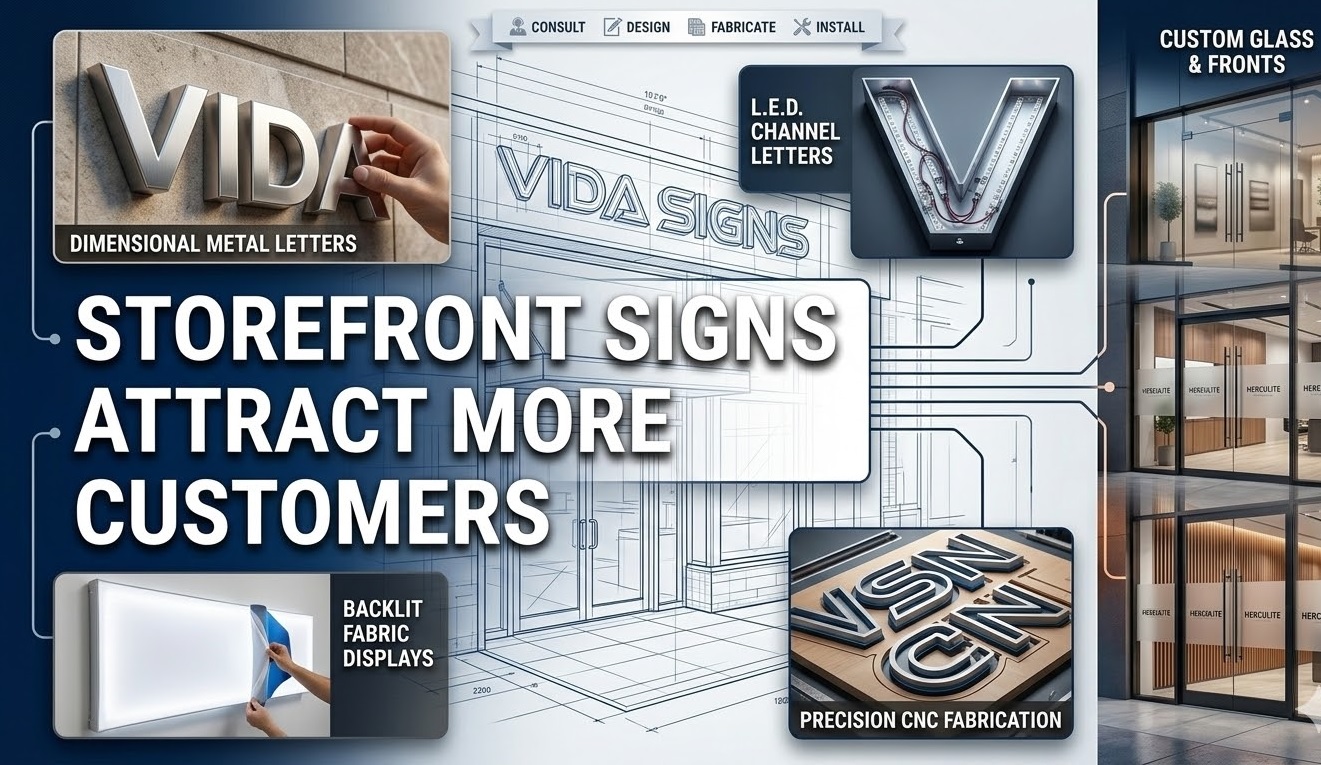
Placement can determine whether a sign performs effectively or disappears into the streetscape. Height, projection, and alignment with foot traffic patterns influence how early someone notices your presence. Thoughtful storefront signage in NYC design may include projecting blade signs for narrow sidewalks or illuminated channel letters for broader visibility.
Small adjustments in positioning frequently produce noticeable shifts in engagement.
Professionally Designed & Installed
Compliance with city regulations, structural safety, and lighting standards requires technical expertise. Experienced custom sign makers manage these complexities while maintaining aesthetic quality, reducing the risk of delays or costly corrections. Professional installation also communicates reliability, a trait customers instinctively value.
Types of Storefront Signs That Drive Foot Traffic
Different business models benefit from different formats. Channel letter signs offer dimensional depth and strong nighttime presence, while window graphics communicate promotions or services without overwhelming the main identity. Projecting blade signs extend outward, capturing attention from both directions along a sidewalk.
Most effective business signs that attract customers integrate layered elements: a primary illuminated sign for brand recognition, subtle window graphics for clarity, and complementary lighting that enhances visibility without overpowering the design. Context always matters, and what works in one neighborhood may not resonate in another.
How Effective Signage Converts Attention Into Foot Traffic
Attention is only the starting point. The transition from glance to entry depends on clarity and perceived credibility. When someone immediately understands what your business offers, they can quickly determine whether it aligns with their needs. Ambiguity may intrigue, yet it often discourages action when time is limited.
High-quality storefront signage in NYC installations contributes to perceived legitimacy. In dense retail corridors, where several stores offer comparable products or services, the one with the most polished, coherent presentation often receives the first visit. People interpret visual cues as indicators of quality, sometimes without realizing they are doing so.
Over time, consistent exposure builds familiarity, and familiarity reduces psychological friction. A sign seen repeatedly becomes a quiet invitation.
Design Tips for Maximum Impact
Use High-Contrast Colors
Contrast improves readability and strengthens visibility from a distance. Clear differentiation between background and lettering allows pedestrians to absorb information without effort, significantly increasing engagement.
Keep Text Short and Memorable
Concise messaging improves recall. Retail signage tips frequently highlight brevity because storefront environments reward simplicity. A clear name and a short descriptor often outperform longer, more descriptive phrases.
Incorporate Lighting Thoughtfully
Illumination extends brand presence into evening hours and increases clarity during overcast days. Halo-lit letters create refinement, while front-lit designs maximize brightness. Balanced lighting supports visibility without overwhelming nearby elements.
Match the Neighborhood Aesthetic
Every district carries visual expectations shaped by architecture and local character. Effective storefront signage in NYC planning respects those cues while maintaining individuality. Harmony with surroundings builds credibility without sacrificing distinctiveness.
Invest in Quality Materials
Durable materials preserve appearance over time and protect your investment. Weather exposure in New York can be demanding, and fading or peeling signage quickly diminishes perceived professionalism.
Why Choose Vida Signs for Your Storefront Signage
Selecting the right partner determines how smoothly a project moves from concept to installation. Vida Signs has established itself as a reliable sign company that NYC businesses trust for technical precision and design integrity. Our team navigates permitting requirements, fabrication standards, and installation logistics while maintaining close attention to brand alignment.
By producing business signs that attract customers, Vida Signs approaches each project as both a marketing asset and a structural installation, recognizing that visual appeal and regulatory compliance must coexist. For businesses seeking refined, durable signage solutions, this combination of expertise delivers measurable value.
Conclusion
Effective signage influences perception long before a customer steps inside. When clarity, branding, placement, and quality align, storefront signage for NYC businesses becomes a consistent driver of recognition and foot traffic. It works continuously, shaping impressions, reinforcing identity, and inviting engagement in one of the world’s most competitive commercial environments.
Ready to transform your storefront into a powerful customer magnet?
At Vida Signs, we deliver expertly crafted signage tailored to your business goals and NYC regulations. From concept development to professional installation, every detail is handled with precision and care.
Call us today at (212)-388-9388 and position your business for stronger visibility and sustained foot traffic.
FAQs
How much does storefront signage cost in NYC?
Costs vary depending on size, materials, lighting, and permit requirements. Basic non-illuminated signs may begin in the lower thousands, while complex illuminated designs can be significantly higher.
Do I need a permit for a storefront sign in New York?
Most exterior signage requires permits from the NYC Department of Buildings, and professional sign companies typically manage this process.
What type of sign attracts the most attention?
Illuminated channel letters and projecting blade signs tend to perform strongly in high-traffic pedestrian areas.
Can I update my existing sign design instead of replacing it?
In many cases, signs can be refaced or upgraded with improved lighting, provided the structure remains sound.
How long does it take to install a custom storefront sign?
Timelines depend on design complexity and permitting, though most projects range from several weeks to a few months.
Do storefront signs really increase foot traffic?
Yes. Clear, well-designed signage significantly improves visibility and brand recognition, encouraging more walk-in customers in competitive urban settings.
