

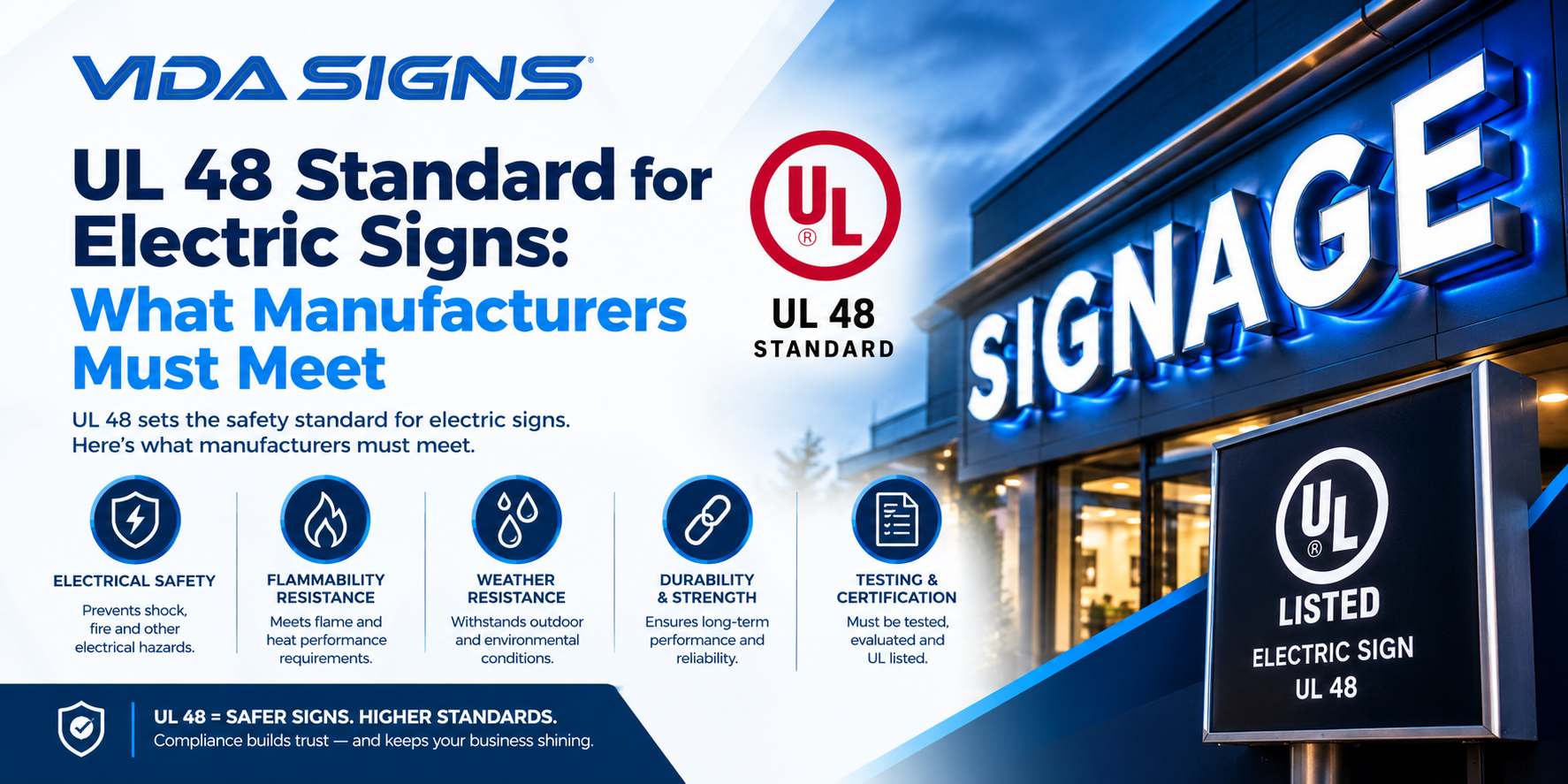
UL 48 Standard for Electric Signs: What Manufacturers Must Meet
06 OctElectric signs involve the use of lighting, wiring, power supplies, enclosures, mounting systems, and in some cases exposure to weather. This combination means that safety is no longer just a design consideration but rather a manufacturing requirement.
When businesses are buying illuminated signs, UL 48 is a standard that is worth understanding because it lays down the safety requirements for certain electrically operated signs and enables manufacturers to assess whether their products have been properly constructed and tested.
The guide outlines the scope of UL 48, the process of certification, the requirements that manufacturers have to meet, and the criteria that people who are going to have the signs installed should look out for.
What Is UL 48?
UL 48 is a safety standard applicable to electric signs, covering the way in which they are constructed and the way in which they perform, and setting out requirements designed to reduce the risks of electric shock, fire, and exposure to environmental conditions.
Manufacturers have reason to be concerned about the standard since a sign is not judged solely on whether it lights up; its wiring, grounding, materials, electrical components, enclosure, and construction are all important.
Who Publishes and Enforces the Standard (Underwriters Laboratories)
UL 48 is issued by Underwriters Laboratories, an organization that creates safety standards and carries out testing and certification of products and systems.
The phrase Underwriters Laboratories signs is sometimes used casually to describe signs carrying a UL certification mark. Technically, however, UL is not a blanket approval issued to every sign. Certification applies to products that have been evaluated under applicable requirements.
UL does not function as a building-code enforcement agency; instead, local authorities having jurisdiction (AHJs), for example, building or electrical inspectors, enforce the relevant codes and might require listed products as part of the permitting or inspection process.
A Brief History & the Current Edition
UL 48 has for many decades served as a safety standard for electric signs, adapting as sign technology has changed.
Modern signs are now making increasing use of LEDs, electronic controls, low-voltage power supplies, digital displays, and more advanced materials; the standard has therefore moved on and is no longer based on the older fluorescent or neon types.
Instead, manufacturers ought to base their work on the edition and specifications that apply to the product being assessed and not on an outdated checklist.
What UL 48 Actually Covers
UL 48 relates to the electrical safety and construction of electric signs that are covered. The requirements set out in it may be applied to entire sign assemblies and not just to the individual light sources.
Types of Signs Included (Channel Letters, LED Neon, Digital Displays & More)
The products that are covered may include illuminated sign constructions such as channel letters, cabinet signs, signs which are illuminated from within, and certain LED-based or digital sign assemblies.
For businesses considering LED signs certification should be considered at the product and assembly level. Simply using LED components does not automatically mean the completed sign is UL listed.
The specific requirements will vary according to the construction and electrical features of the sign; the manufacturer must decide which regulations apply before carrying out production and obtaining certification.
What Falls Outside UL 48’s Scope
UL 48 does not cover every illuminated product or every sign-related component.
Certain equipment might be covered by different UL standards or certification categories. Although a power supply, LED module, controller, or other component may have its own applicable requirements, this does not mean that the entire sign has been assessed in accordance with UL 48.
That point is important since certification of components and certification of the complete system are not necessarily interchangeable.
Why UL Certification Matters for Electric Signs
It is not just a label included for marketing purposes; it can have practical effects on the process of installation and inspection.
Electrical & Fire Safety
The purpose of UL 48 is to deal with safety hazards that can reasonably be expected to arise with respect to electric signs covered by the standard. Tests may look at various aspects of construction, including electrical connections, insulation, grounding, mechanical protection, and resistance to environmental conditions.
This contributes to electric sign safety by giving manufacturers defined requirements against which their products can be evaluated.
Building Code & Inspection Requirements
Local electrical and building codes may require listed or approved equipment, particularly for permanently installed electrical signage.
An inspector may look for an appropriate certification mark or documentation during the permitting or inspection process. Requirements vary by jurisdiction, so manufacturers and sign owners should confirm local rules before installation.
Liability Protection for Sign Owners
A properly certified sign does not eliminate every possible risk. Installation still matters, and the sign must be used as intended.
It is useful to obtain proper documentation showing that the recognized safety requirements have been met when buying a product from a qualified manufacturer, since this can be important should any questions come up during an inspection, a maintenance situation, or an insurance review.
What Manufacturers Must Meet to Be UL Listed
UL listing involves more than putting a UL mark on a finished product. Manufacturers must meet applicable construction and testing requirements and maintain the conditions under which certification was granted.
Required Safety Testing (Grounding, Strain Relief, Water Exclusion)
Depending on the sign construction, testing can address grounding and bonding, wiring, insulation, spacing, strain relief, enclosure construction, and protection against water or moisture.
Outdoor signs receive particular attention because rain and other environmental exposure can affect electrical components. A sign designed for exterior use must be constructed appropriately for those conditions.
The manufacturer must also use components and construction methods consistent with the certification requirements.
Component Standards & UL 879
UL 879 is also a significant standard in the field of signage; it covers sign components and accessories, such as various electrical and mechanical components used in the construction of signs.
That does not make UL 879 a replacement for UL 48. The two standards address different aspects of sign safety and certification.
Manufacturers need to identify which standard applies to the complete product and which requirements apply to individual components.
Ongoing Factory Inspections
Certification is not necessarily a one-time event followed by unrestricted production.
For certified products, UL’s follow-up services can include inspections intended to verify that the manufacturer continues producing products in accordance with applicable certification requirements.
This helps prevent a situation where the tested product differs substantially from what is actually being manufactured.
How to Tell If a Sign Is UL Listed
A legitimate certification mark should be treated as something to verify, not merely something to assume.
Where to Find the UL Label
The UL mark is commonly placed on the sign, its electrical enclosure, or another accessible component, depending on the certification arrangement.
The location can vary by product. A manufacturer should be able to explain where the applicable marking is located and provide supporting certification information when requested.
What the Label Actually Tells You
A UL mark indicates that the product has been evaluated under the applicable UL certification requirements.
It does not mean the sign is approved for every possible installation. Mounting, wiring, electrical service, location, and local code compliance still matter.
This is why UL listed signs should always be considered alongside the installation requirements for the specific project.
UL 48 vs. UL 879: What’s the Difference?
The simplest distinction is that UL 48 primarily addresses electric sign assemblies, while UL 879 covers certain sign components and accessories.
A manufacturer may use components that comply with UL 879 while also having a complete sign evaluated under UL 48. One does not automatically substitute for the other.
For buyers, asking whether the UL 48 electric signs being supplied are appropriately certified is more useful than asking only whether individual LEDs or power supplies carry a UL mark.
What Happens If a Sign Isn’t UL Listed
Not every sign without a UL listing is automatically unsafe, and local requirements differ. However, using an uncertified product can create practical problems.
Permit & Inspection Risks
An AHJ may require listed equipment or additional documentation before approving an installation. If a sign does not meet the applicable requirement, the owner may face delays, modifications, or replacement costs.
Insurance & Liability Risks
Insurance requirements vary by policy and location, but documentation of compliant equipment can become relevant when an incident occurs.
A sign owner should therefore avoid treating certification as an optional cosmetic feature. It is part of the broader compliance picture.
How Vida Signs Ensures Every Sign Meets UL 48
Vida Signs takes electrical safety and manufacturing compliance seriously when producing illuminated signage. The goal is not just a sign that looks good when switched on, but one designed with the electrical and construction requirements of the project in mind.
Whether a client needs UL-listed signs for a commercial property or is developing a new illuminated installation, they should consider certification and component requirements from the beginning rather than addressing them at the end.
For businesses comparing custom signs in NYC, Vida Signs can help discuss sign construction, illumination options, electrical considerations, and project requirements before fabrication.
Conclusion
UL 48 provides an important safety framework for covered electric signs, but certification is only one part of a compliant installation. Manufacturers must meet applicable construction and testing requirements, use appropriate components, and maintain production controls.
For sign buyers, the practical takeaway is straightforward: ask what has actually been certified, verify the applicable marking or documentation, and make sure the installation also meets local requirements.
Choose a Sign Manufacturer You Can Trust
When electrical safety and compliance matter, choosing the right sign manufacturer is just as important as choosing the right design. Vida Signs works with businesses to create illuminated signage with careful attention to construction, components, and applicable safety requirements. Whether you need channel letters, LED displays, or another custom electric sign, our team can help you understand your options before fabrication begins. If you are comparing signage companies in NYC, talk to Vida Signs about your project, certification requirements, and installation needs. Let’s create signage that looks professional, performs reliably, and is built with safety in mind from the start.
FAQs
What is UL 48?
UL 48 is a safety standard covering certain electrically operated signs. It establishes requirements addressing aspects of sign construction and performance, including electrical safety and protection against relevant hazards.
Is my LED sign UL listed?
Using LEDs does not automatically make a sign UL listed. Check the sign’s certification mark and ask the manufacturer for documentation confirming whether the complete sign assembly has been evaluated.
Does UL certification matter for signs?
It can matter for safety, permitting, inspection, and project compliance. Local requirements determine whether a particular certification is required for a specific installation.
What does “UL” mean on a sign?
A UL mark indicates that the product has been evaluated or certified under applicable UL requirements. The exact meaning depends on the mark and certification category.
What’s the difference between UL 48 and UL 879?
UL 48 primarily addresses covered electric sign assemblies. UL 879 addresses certain sign components and accessories. Manufacturers may need to consider both depending on the product.
Can a non-UL-listed sign pass a building inspection?
It depends on the jurisdiction, applicable codes, and the specific sign. An inspector may require listed equipment or other evidence of compliance before approving an installation.
Does UL 48 apply to all types of electric signs?
No. UL 48 has a defined scope. Some illuminated products, components, or equipment may instead fall under other standards or certification categories.
How can I confirm a sign manufacturer is UL certified?
Ask the manufacturer for its applicable certification information and verify that the certification corresponds to the actual sign or product being supplied. Do not rely solely on a general claim of certification.
