

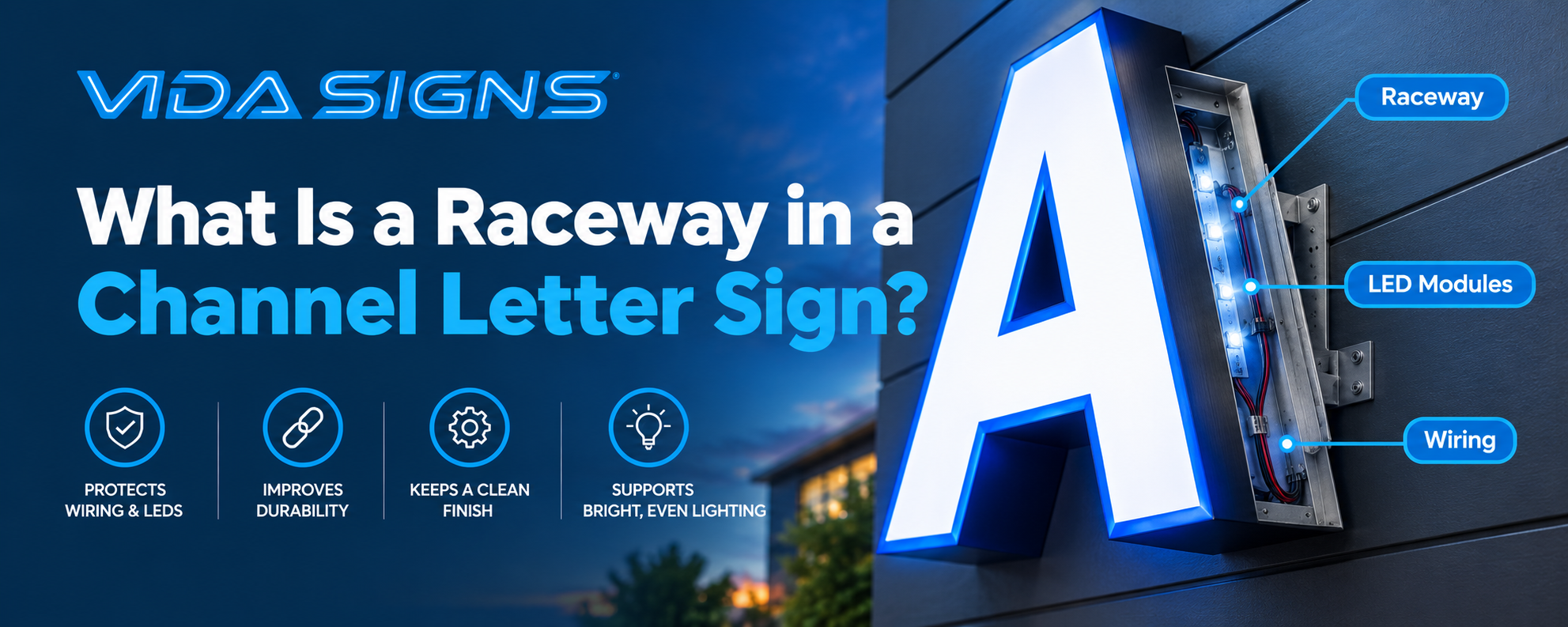
What Is a Raceway in a Channel Letter Sign?
06 OctChannel letters can be mounted directly onto a building, but that is not always the most practical option. In many installations, the letters are attached to a long, narrow metal enclosure called a raceway. It holds wiring and electrical components while giving the sign a secure mounting surface.
If you have ever wondered what is a raceway on a sign, the short answer is that it is a metal box or channel behind the letters that houses the sign’s electrical connections and provides a single mounting point.
This article explains how raceways work, how they compare with flush mounting, and when each option makes sense.
What Is a Raceway, Exactly?
A raceway is a fabricated metal enclosure installed behind channel letters. Instead of drilling separate mounting holes and routing wiring for every individual letter, the letters are secured to the raceway, while the raceway itself is attached to the building.
A raceway sign can therefore make the installation process more organized, particularly when several illuminated letters need to be installed together.
Where the Term “Raceway” Comes From
The word raceway refers to a pathway or enclosure used to contain and protect electrical wiring. In signage, the same basic idea applies. The raceway creates a dedicated space where wires, connectors, and other electrical components can be routed without being exposed directly on the building surface.
It is not simply decorative. It performs a practical job.
What a Raceway Looks Like on a Building
From the front, you may mostly notice the channel letters themselves. The raceway sits behind them, usually as a horizontal or vertical metal box that follows the general arrangement of the sign.
Depending on the design and installation, the enclosure may be visible around or beneath the letters. A properly designed raceway sign can be painted to coordinate with the facade, making the mounting structure less noticeable.
How Raceway Mounting Works
Raceway mounting gives the installer a single surface for securing multiple channel letters and managing their electrical connections.
Materials Used in Raceway Construction
Aluminum is commonly used because it is lightweight, durable, and corrosion-resistant. A typical aluminum raceway channel letter system can be fabricated to the dimensions required for the specific sign.
The raceway can also be finished in a color that works with the building, sign cabinet, or channel letters.
Electrical Components Housed Inside
The raceway can contain wiring and electrical connections associated with illuminated channel letters. Keeping these components inside an enclosure helps organize the installation and protects them from direct exposure.
For channel letters designed as LED signs for business, the raceway may also accommodate power supplies and related connections, depending on the sign’s design.
How Raceways Are Installed, Step by Step
First, the sign location and mounting surface are measured. The raceway is then fabricated according to the letter layout and electrical requirements.
Once ready, the raceway is positioned and secured to the building. The electrical connections are routed through the enclosure, and the individual channel letters are attached to the raceway.
Finally, the system is connected and tested. The exact process varies with the building material, sign size, electrical configuration, and local requirements.
Raceway Mount vs. Flush Mount: What’s the Difference?
The main difference between flush mount vs. raceway installation is where the letters are physically secured.
With flush mounting, each letter is attached directly to the building. With raceway mounting, the letters are attached to a metal enclosure, and that enclosure is mounted to the building.
Pros of Raceway Mounting
The biggest advantage is simplified installation. Instead of creating numerous mounting points for individual letters, the installer works with one primary mounting structure.
The raceway can also make electrical routing more manageable and may reduce the number of penetrations required through the facade.
For many projects, these practical benefits are more important than having a completely concealed mounting system.
Cons of Raceway Mounting
The main drawback is visibility. The raceway adds another physical element behind the letters, and it can be noticeable from certain angles.
This is where the raceway pros and cons need to be considered alongside the building’s architecture rather than judged in isolation.
Pros of Flush Mounting
Flush mounting provides a clean, direct appearance because the letters sit against the building surface without a continuous backing structure behind them.
For architectural facades where minimal visual hardware is important, this can be appealing.
Cons of Flush Mounting
Flush mounting generally requires individual mounting points and more direct coordination between the letters, wiring, and building surface.
It may also require more penetrations into the facade. That can become an issue when working with older masonry, finished surfaces, or buildings where alterations are restricted.
So, when comparing flush mount vs raceway, appearance is only one part of the decision.
When Raceway Mounting Makes the Most Sense
Raceway mounting is often useful when the building or project has practical restrictions that make direct mounting difficult.
Older or Structurally Fragile Facades
Older buildings may have masonry, stone, decorative finishes, or other surfaces where extensive drilling is undesirable. A raceway can consolidate mounting points and provide a more controlled installation.
A site assessment is still important because not every older facade can support the same type of hardware.
Landlord & Lease Requirements
Property owners and landlords sometimes have specific requirements for exterior signage. These can involve mounting methods, facade penetrations, sign dimensions, colors, or how electrical components are handled.
In some properties, a raceway may be preferred because it keeps the installation more contained and easier to manage.
Faster, Lower-Cost Installations
Because several letters can be installed onto one fabricated structure, raceway mounting may simplify labor in some projects, which can reduce installation time and overall costs.
However, pricing depends on the sign’s size, materials, building conditions, electrical work, and fabrication requirements.
Raceway vs. Wireway: Are They the Same Thing?
The terms are sometimes used interchangeably, but they can describe different structures.
Key Structural Differences
A raceway used for channel letters is generally designed to serve as both a mounting structure and an enclosure for electrical components.
A wireway, by contrast, is primarily intended to provide a protected pathway for wires and cables. It may not be designed to carry the same mounting function as a sign raceway.
The terminology can also vary between sign manufacturers and contractors, so the actual design matters more than the name.
Which Option Costs Less to Install
There is no universal lower-cost option. The final price depends on the size, material, access conditions, electrical requirements, and installation method.
A properly designed raceway may reduce labor in some channel letter installations, while a separate wireway may make sense for a different electrical layout.
Aesthetic Considerations for Raceway Signs
A raceway does not have to look like an afterthought. Its design and finish can make a noticeable difference.
Painting & Color-Matching the Raceway
Painting the enclosure to coordinate with the building is one of the simplest ways to reduce contrast. A dark raceway against a dark facade, for example, may become much less noticeable.
Color matching is particularly useful when the sign is viewed from street level or from an angle.
Minimizing Raceway Visibility
The raceway can be sized and positioned to work with the letter layout rather than simply functioning as a rectangular box behind it.
Careful dimensions, spacing, mounting height, and paint selection can all help the enclosure blend into its surroundings. It will still be there, of course. The goal is simply to make it visually secondary.
How Vida Signs Approaches Raceway & Channel Letter Installation
At Vida Signs, we treat the mounting method as part of the overall sign design rather than just an afterthought.
Site Surveys Before Every Quote
When it comes to NYC signs, a site survey can reveal several important details. Our team can assess the facade, available mounting areas, access, dimensions, and other installation considerations before recommending an approach.
This helps determine whether raceway mounting or direct channel letter mounting is appropriate for the location.
Custom Fabrication for a Seamless Look
Each building presents different requirements, so a raceway may be fabricated around the actual letter layout and site conditions.
The same attention to mounting applies across illuminated signage, including Custom LED Neon Signs.
Conclusion
A raceway is more than a metal strip behind channel letters. It provides a mounting surface, organizes electrical components, and can reduce the number of individual penetrations needed on a building.
For businesses planning exterior signage, raceway signs can also be designed around the building and installation requirements.
Still wondering what is a raceway sign and whether it’s the right choice? The answer depends on the facade, lease requirements, sign design, budget, and the appearance you want. A careful site assessment usually makes that decision much easier.
Vida Signs can evaluate your building, discuss mounting options, and fabricate a signage solution suited to the facade. Call us on 212 388 9388 or visit https://vidasigns.com/ to discuss your project and request a custom quote.
FAQs
What is a raceway on a channel letter sign?
A raceway is a metal enclosure mounted behind channel letters. It provides a mounting surface for the letters while also housing and organizing electrical wiring and related components.
Is raceway mounting cheaper than flush mounting?
It can be in some installations because multiple letters can be mounted to one structure. However, the total cost depends on fabrication, materials, building conditions, electrical work, and installation requirements.
Does a raceway show on the building?
It can. The enclosure sits behind the letters and may be visible from certain angles. Its visibility can often be reduced through careful sizing, placement, and color matching.
Can a raceway be painted to match my building?
Yes. Raceways can generally be finished in a color selected to coordinate with the building facade or the overall sign design.
How many holes does raceway mounting require compared to flush mounting?
Raceway mounting can reduce the number of facade penetrations because several letters attach to the raceway rather than being individually secured to the building. The exact number depends on the installation.
What’s the difference between a raceway and a wireway?
A raceway used for channel letters can provide both mounting support and electrical enclosure space. A wireway is generally focused on routing and protecting wiring rather than supporting the sign itself.
Is raceway or flush mounting better for older buildings?
The appropriate option depends on the facade and its structural condition. A raceway may be useful when minimizing individual penetrations is important, but the building should be assessed before selecting a mounting method.
Do landlords typically require raceway mounting?
Some landlords or property managers may specify raceway mounting or other installation requirements, but there is no universal rule. Lease and property guidelines should be checked before fabrication.
What material is used for sign raceways?
Aluminum is commonly used because it is lightweight and resistant to corrosion. Other materials may be selected depending on the sign’s size, location, structural requirements, and design.
Does Vida Signs install raceway-mounted channel letters?
Yes. Vida Signs can assess the installation location and determine an appropriate mounting approach based on the building, sign design, electrical requirements, and project specifications.
